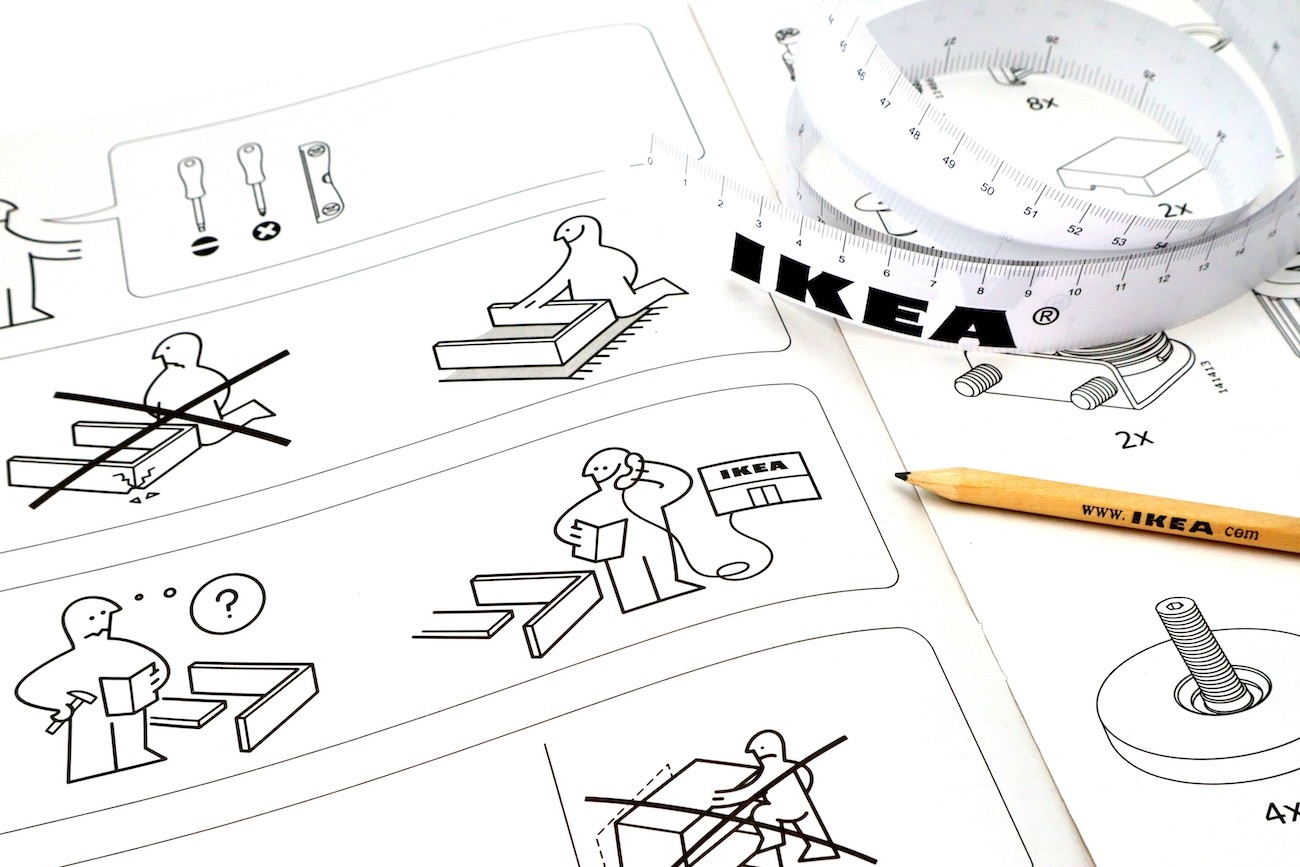
If you’ve ever built a piece of IKEA furniture, you know the moment. You open the box, spread the parts across the floor and stare at a small paper booklet filled with tiny drawings. No words or explanations; just arrows, dots and the suggestion that this should all make sense.
At some point, you’re almost certain you’ve done something wrong. There’s usually one extra screw (or one missing screw). Or a panel that looks suspiciously upside down. And yet, somehow, most of the time, the furniture stands.
That experience is not an accident.
In the early days of IKEA, the company faced a costly problem. Its flat-pack furniture was selling around the world, but written instructions were not keeping up. Every new country meant new translations and every new language introduced confusion, errors and expense. Customers misread steps, assembled pieces incorrectly and blamed the product.
The solution was not better writing. It was no writing at all.
Rather than translating instructions into dozens of languages, IKEA removed words entirely. In their place came simple line drawings. Hands pointed, arrows moved and screws appeared at the exact moment they were needed. Little human figures showed scale, orientation and sequence. Anyone, anywhere, could understand what to do next without reading a single sentence.
The change worked! Assembly errors dropped, customer satisfaction improved and costs went down. What looked like a design choice turned out to be a communication breakthrough.
The genius of IKEA’s instructions is not that they’re clever; it’s that they’re merciful. They assume the person on the other side is tired, distracted and probably building furniture on a living room floor. The instructions do not explain; they guide. They do not impress; they serve.
And that’s the lesson.
Most organizations believe clarity comes from saying more. More pages, more explanations and more features spelled out in finer detail. But clarity is not created by volume; it’s created by understanding how people actually experience what you are giving them.
That is where we do our best work. Radiant helps organizations remove friction, not add language. We help them design brands, messages and systems that people can navigate without effort. The goal is not to sound smart, but rather to be understood.
IKEA did not win by talking louder. They won by making the next step obvious. And when communication does that, people don’t just understand it. They trust it.